

Why should I study this subject?
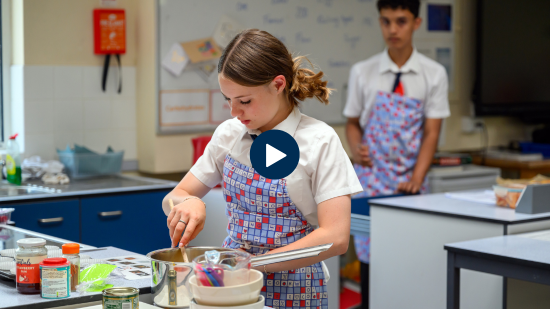 Watch GCSE Food & Nutrition Video »
Food and Nutrition provides a dynamic, fun and social way to learn. The specification is taught through a mix of practicals and coursework, which will cultivate your curiosity of food, through science and its aesthetic qualities. This will develop your ability to become an informed consumer, giving you the opportunity to make the right choices for you, but have the understanding to change them to suit your lifestyle
Understanding and working with food is a life skill that is important for your wellbeing. The course will give you skills that will be valuable throughout your life, through practical application and the understanding of nutrition, whilst it is also a subject that opens a variety of career choices which will make good use of your skills and ability to think on your feet.
What will I study?
We focus on practical cooking skills that will help you develop an understanding of nutrition, food provenance and the working characteristics of food.
The course content includes:
- Food, Nutrition and Health
- Food Science
- Food Safety
- Food Choice
- Food Provenance
How will I be assessed?
The exam board for this course is AQA and assessment is divided between non-exam assessment (NEA) and a final written exam at the end.
The contents of the course are divided over the six terms in Year 10, so that the food preparation skills covered practically reflect a carefully planned amalgamation of the content. You will keep an accurate account of all work covered in Year 10, so it is easily accessible for your NEA tasks in Year 11.
In Year 10, GCSE Food Preparation and Nutrition is assessed through a mixture of practical work, tests, and small project tasks that help students to build the skills they require for the official assessments in Year 11.
Paper 1: Food Preparation and Nutrition
- Topics covered: nutrition and health, food science, food safety, food choice, food provenance
- Exam duration: 1 hour 45 minutes
- 100 marks – 50% of GCSE
NEA Task 1: Food Investigation
- Investigation on the scientific functions of ingredients
- Pupils are given a choice of three tasks to choose from
- Assessed by a written report (1500 to 2000 words) including photographic evidence of practical investigation
- 30 marks – 15% of GCSE
NEA Task 2: Food Preparation Assessment
- A practical exam – plan, prepare, cook and present a menu of three dishes suitable for your chosen task
- Pupils are given a choice of three tasks to choose from
- Assessed by written portfolio including photographic evidence of the three final dishes.
- 70 marks – 35% of GCSE
Are there higher and foundation tiers?
No. All students sit the same exam and study the same content, with questions designed to allow achievement across the full range of grades (9–1).
Are there any trips or enrichment opportunities?
Last year, we ran a GCSE Food and Art Trail trip to London.
Will this course be good preparation for post-16 study?
GCSE Food and Nutrition prepares students for post-16 study by developing practical cooking skills alongside scientific understanding of nutrition, food safety, and food science. It encourages independent research, problem-solving, and planning, providing a strong foundation for further study in subjects such as nutrition, hospitality, catering, or health-related courses.